Wyndham Hotels & Resorts
- 4.7
- Rating
- 1.00M
- Installs
- Free
- Price

 Analysis by App-foxy
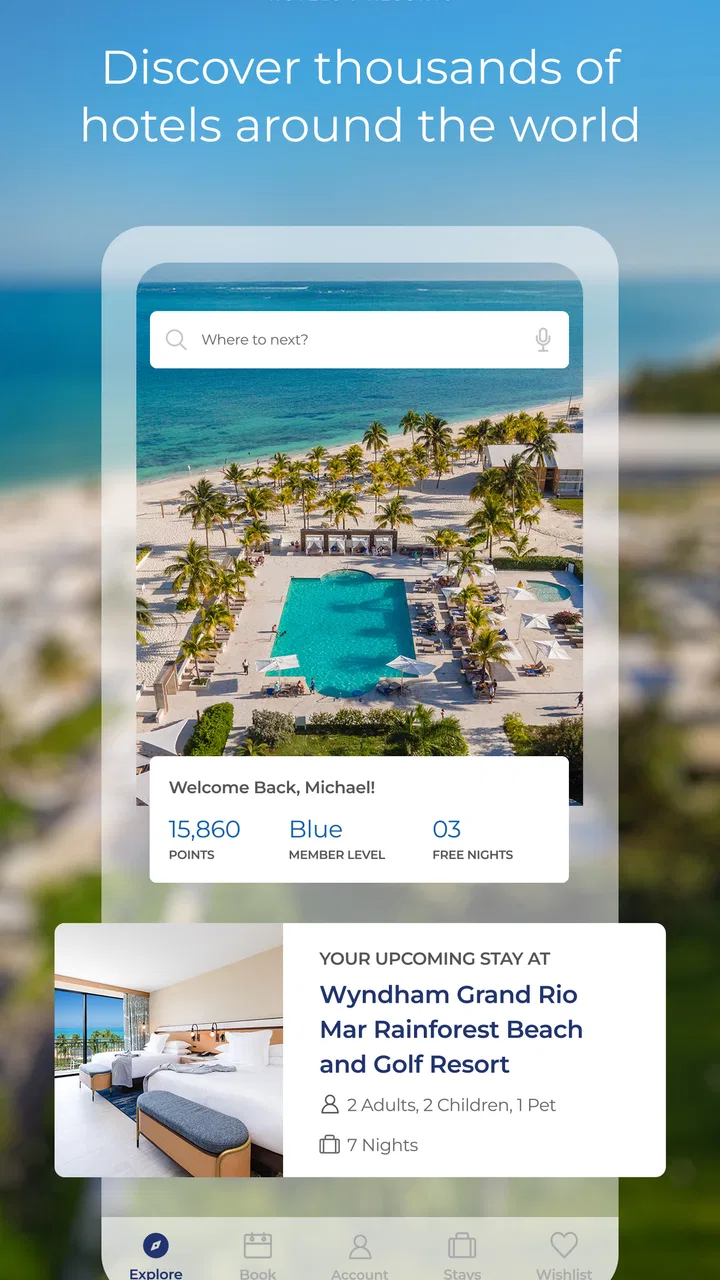
I found Wyndham Hotels & Resorts most useful when I treated it as a focused hotel-booking companion rather than a complete travel planner. It is a free Travel & Local app from Wyndham Hotel Group, aimed at people who already want to compare and reserve Wyndham properties while they are planning a trip or standing in an unfamiliar place. The promise is straightforward: access to more than eight thousand nine hundred hotels worldwide through a single mobile experience.
That focus matters. I did not approach it as a replacement for a map, a flight app, a restaurant guide, or a broad hotel marketplace. Its best role is narrower and more practical: find a Wyndham stay, inspect the available choice, and move through the booking process without having to handle several unrelated travel tools at once. For a traveler who prefers a familiar hotel group, that can reduce decision fatigue. For someone who wants every brand and independent property in one search, the same focus may feel limiting.
How the app feels to use in different situations
I find the app easiest to judge by the kind of trip I’m planning: a quick Wyndham search, a stay I can arrange in advance, or a booking that depends on specific room needs. In this section, I’ll focus on how that brand-specific approach can change the amount of searching and checking a traveler has to do. The next section looks more closely at the practical tradeoffs behind that convenience.
You May Also Like

 Blood Strike: 2.5 Anniversary
Blood Strike’s Loadouts Turn Every Drop Into a Tactical Gamble
A close look at Blood Strike’s custom loadouts: how fast access to signature weapons reshapes its battle royale rhythm, rewards preparation, and narrows the gap between fights.

 Pandora - Music & Podcasts
Pandora’s Music Is Easy to Start, but Harder to Recover
Pandora’s strength is its low-effort path from a seed to a station. Its weak spot is how much confidence it asks you to place in connection, setup, and quiet recovery.

 8 Ball Pool
 Is Built on Rivalries, Rematches, and Routine
A close look at the rivalries, rematches, shared routines, and unanswered safety questions that turn a quick pool match into a persistent mobile community.

 Samsung Music
’s Quiet Strength Is Playing What You Already Own
Its reach comes less from spectacle than from dependable access to a personal library. That simplicity is both the app’s strongest retention engine and its ceiling.

 AccuWeather: Weather Radar
AccuWeather Review: A Quick, Clear Forecast for Everyday Decisions
For everyday plans, the best forecast is the one you can understand quickly. AccuWeather makes rain timing, radar, and local conditions easy to act on, with a few trade-offs.

 Hill Climb Racing
Why Hill Climb Racing Still Turns Crashes Into One More Run
A tiny car, a bumpy hill and one more upgrade: Hill Climb Racing keeps resurfacing because its simple chaos makes every near-miss feel personal.
More From Our News Desk



Readability and navigation during a busy search
My first impression was that the app’s main task is easy to understand. I could begin with the basic travel questions that matter most: where I want to stay and when I need the room. That direct approach is particularly helpful on a phone, where a crowded screen can make even a simple reservation feel tiring. The app’s identity is also clear from the start, so I was not left wondering whether I had opened a loyalty tool, a general travel marketplace, or a particular hotel’s app.
For readers who rely on larger text, strong contrast, screen magnification, or extra time to interpret a page, the practical experience will depend heavily on the device’s own accessibility settings and the way the current screen responds to them. I would not assume that every element will remain equally comfortable after text enlargement. The safest approach is to test a destination search before committing to a reservation, especially if reading dense room details or rate conditions is difficult.
I also recommend slowing down at the point where the app presents room choices. The attractive part of a booking screen is usually the headline price or room name, but the useful information is often in the details: what kind of room it is, which conditions apply, and whether the selected option matches the traveler’s actual needs. I would read those sections rather than relying on the first visible description. This is a small habit, but it prevents the common mistake of choosing a room that looks suitable at a glance and discovering later that an important condition was overlooked.
The app has a sensible advantage over searching through a mobile browser: the experience is built around Wyndham properties instead of asking me to filter a huge mixture of unrelated hotels. That can make the route from destination to reservation feel shorter. The trade-off is that I have to know, or be comfortable with, the Wyndham network. If I am simply looking for the most accessible room, the lowest total cost, or the closest property regardless of brand, a broad booking service may give me a wider starting point.
Motor and sensory considerations before confirming a room
Hotel booking is an interaction-heavy task. It involves tapping calendars, opening menus, reviewing room cards, entering personal information, and checking a final summary. For people with limited dexterity, tremors, fatigue, or difficulty making precise selections, the most demanding moments are not necessarily the first search fields. They are the transitions between dates, rooms, guest information, and payment or confirmation steps. I would avoid doing the whole process while walking, in a moving vehicle, or under poor lighting.
A useful workflow is to prepare the destination and dates in advance, then complete the reservation while seated. I would also keep the phone in a stable position instead of trying to operate it one-handed in a crowded station or airport. If a traveler uses voice input or an assistive keyboard, it is worth checking every automatically filled field before continuing. Travel names, dates, and room selections are exactly the kind of details that can be entered incorrectly when a person is rushing.
For sensory comfort, I found the focused nature of the app preferable to a general travel feed filled with promotions, unrelated destinations, and constant visual changes. There is less need to scan through an enormous catalog of brands. Still, hotel information can be visually dense, and a user with low vision or cognitive fatigue may need breaks between the search and confirmation stages. I would take screenshots or write down the selected property and dates only as a personal reference, not as a substitute for checking the final booking record inside the app.
People who are sensitive to unexpected sound should review the app in a quiet setting and use their phone’s normal sound controls. I would not depend on audio cues alone for a reservation. Important travel information should be confirmed visually or through a support channel that the traveler already trusts. Likewise, anyone who has difficulty distinguishing colors should pay attention to text labels and full descriptions rather than interpreting availability or selection from color alone.
One practical strength is that the app keeps the user centered on a hotel reservation instead of turning the process into a general travel-content session. That can help users who are easily distracted or who prefer a predictable, limited task. The weakness is that a focused hotel app cannot solve every access question by itself. A traveler may still need to contact the property directly about room layout, entrance access, bathroom configuration, parking, or other personal requirements. I would make that contact before arrival whenever a particular feature is essential.
Situational access: from planning at home to arriving late
The most realistic use case for me is a short-notice overnight stay. Imagine finishing a work trip later than expected, opening the app in a quiet corner, searching the destination, and choosing a nearby Wyndham property instead of comparing dozens of unrelated listings. In that situation, the app’s narrow purpose is a benefit. I can concentrate on finding a place to sleep rather than browsing attractions or reading endless editorial content.
It is also useful for a planned road trip where I already know which hotel group I prefer. I can check possible stops along the route and keep the lodging search separate from navigation. I would still use a map application to judge the actual driving route, traffic, and nearby entrances. The hotel app can help me choose the stay, but it should not be treated as a full replacement for route planning.
Travelers with limited data, an older phone, or a small screen may appreciate the app’s focused purpose, although I would complete the important parts of a reservation while connected to a reliable network. A weak connection is a poor moment to enter sensitive details or repeatedly reload search results. Saving confirmation information in a secure place is sensible, particularly when a traveler expects to arrive somewhere with unreliable service.
The app can also suit families who want to keep hotel selection simple. One person can search while another checks the dates and room type. That shared review is valuable because accessibility and comfort needs are often personal: a quiet location, fewer stairs, a particular bed arrangement, or easier parking may matter more than a general star rating. I would use the app to identify the property, then verify any requirement that could affect the stay directly with the hotel.
For solo travelers who have difficulty reading signs or navigating unfamiliar buildings, booking ahead can reduce pressure on arrival. However, the app does not remove the need to plan the last part of the journey. I would note the property name, address, check-in information, and a backup way to access the reservation before leaving a comfortable environment. A smooth booking screen does not guarantee a smooth arrival, especially at night or in an unfamiliar neighborhood.
What the Wyndham focus does better than usual alternatives
Compared with a broad hotel marketplace, this app offers a simpler brand-specific search. I do not have to filter out properties that I would never consider, and I can approach the booking process with a clearer expectation of the hotel group involved. That is a genuine advantage for repeat guests, business travelers with established preferences, and families who want to stay within a familiar network.
Compared with booking through a mobile browser, the dedicated app feels more appropriate when I expect to search or reserve more than once. The app is already organized around the hotel group, so I do not need to begin from a general web search every time. Its current version is 5.13.0, and the app has been available since December twelfth, two thousand thirteen, which gives it a long-running presence rather than the feel of a newly assembled booking experiment.
The alternative can be better when I am comparing the entire market. A general service may expose independent hotels, different chains, apartment rentals, and more varied sorting tools in one place. It may also be preferable when I need to compare total prices across brands or when I am not committed to Wyndham. The choice is therefore less about which app is universally superior and more about whether brand focus helps or restricts the search.
I would also separate hotel discovery from accessibility verification. A broad platform may make it easier to begin with a specific requirement, while a direct hotel app may make the final reservation feel more connected to the property group. Neither approach should replace asking precise questions when the traveler’s safety, mobility, hearing, vision, or sensory comfort depends on an exact room feature.
Remaining barriers I would plan around
The biggest limitation is not that the app has too few travel functions; it is that a hotel reservation can contain more nuance than a compact mobile screen comfortably shows. Travelers may need to compare room descriptions, dates, occupancy, policies, and location details while also considering personal access needs. That creates a risk of moving too quickly through a polished booking flow.
I would also be cautious about assuming that a property’s availability means that the exact room arrangement I need is guaranteed. If an accessible bathroom, step-free route, visual alert, quiet position, or other feature is essential, I would contact the hotel and ask for confirmation. The app can be the starting point for the reservation, but the property remains the place to verify the physical details of the stay.
Another barrier is brand coverage. More than one million people have installed the app, and its average rating is 4.6 from around sixty-three thousand ratings, so it clearly works well for a substantial audience. Those figures suggest a mature and widely used product, but they do not mean it will fit every traveler. A strong reputation among Wyndham guests cannot compensate for a destination where another hotel group is better located or better equipped for an individual’s needs.
The age rating is Everyone, which makes the app broadly suitable from a content perspective. That does not remove the need for adult help when a child is involved in choosing dates, entering guest information, or handling a reservation. I would also avoid sharing a phone during the payment or personal-information stages unless the other person is trusted and the screen is private.
Finally, I would not choose this app if my main goal were to build a complete itinerary. It is not where I would expect to manage flights, public transport, sightseeing, restaurant bookings, or detailed destination accessibility research. Keeping those tasks in the right tools may feel less convenient, but it produces a clearer and safer travel plan than forcing one hotel app to do everything.
My inclusive verdict for Wyndham travelers
After using it as a hotel-booking tool, I see Wyndham Hotels & Resorts as a practical choice for travelers who value a focused search within the Wyndham Hotel Group. It is free, available for Everyone, and supports a large worldwide hotel network without burying the main task beneath unrelated travel features. The app is most comfortable when I plan in a calm setting, read room details carefully, and treat accessibility questions as something to verify with the property rather than infer from a search result.
Its strongest inclusive quality is the reduction of choice overload. A traveler with limited attention, low energy, or a need for a predictable process may find a brand-specific booking route easier than a huge marketplace. The app’s focused structure can also help a companion assist with the search without having to navigate a broad collection of travel products.
Its main weakness is that digital simplicity cannot guarantee physical access at the hotel. Users with motor, sensory, vision, hearing, or mobility requirements should allow extra time, use device settings that make reading and tapping easier, and confirm critical room features before arrival. I would especially avoid last-minute assumptions when a particular layout or service is necessary.
For a Wyndham regular, I would recommend installing it. For someone searching the entire lodging market, I would use it alongside a broader comparison tool rather than alone. In my experience, the app earns its place by making one important travel job more manageable: finding and reserving a Wyndham stay. It is a good fit when that is exactly what I need, and a poor fit when I expect one app to answer every question about a trip.
The result is a balanced, useful travel companion rather than an all-purpose accessibility guide. If I were recommending it to a friend, I would say: use it to narrow the hotel decision, take your time with the final details, and contact the property whenever a specific access need matters. That combination gives the app its best chance of supporting a comfortable stay.
FAQs for Wyndham Hotels & Resorts
01What features does the Wyndham Hotels & Resorts app offer?
The Wyndham Hotels & Resorts app provides a seamless booking experience with features like easy reservation management, exclusive member discounts, and the ability to track your rewards points. Users can browse a wide selection of hotels, view detailed descriptions, and access special offers directly through the app.
02Is the Wyndham Hotels & Resorts app available for both Android and iOS?
Yes, the Wyndham Hotels & Resorts app is available for download on both Android and iOS devices. You can find it on the Google Play Store for Android users and the Apple App Store for iOS users, ensuring accessibility for a broad range of mobile devices.
03How does the rewards program work in the Wyndham app?
The Wyndham Rewards program allows users to earn points for every stay booked through the app. These points can be redeemed for free nights, gift cards, and other benefits. The app also provides a convenient way to track your points balance and find exclusive member deals.
04Are there any booking fees when using the Wyndham Hotels & Resorts app?
No, booking through the Wyndham Hotels & Resorts app does not incur additional booking fees. The app is designed to provide a hassle-free experience, allowing you to reserve rooms directly and take advantage of exclusive app-only promotions without extra charges.
05Can I manage my reservations through the Wyndham app?
Absolutely, the Wyndham Hotels & Resorts app allows you to easily manage your bookings. You can view upcoming reservations, make changes to existing bookings, and even cancel if needed. The app provides a user-friendly interface to handle all your travel needs efficiently.
Pros
- Easy booking process via the app.
- Access to exclusive member discounts.
- User-friendly interface for navigation.
- Real-time reservation updates.
- Wide variety of hotel options available.
Cons
- Occasional slow loading times.
- Limited offline functionality.
- Some features require membership.
- Notifications can be overwhelming.
- In-app support could be improved.

Wyndham Hotels & Resorts
Gallery